What to Know
The crunch looks simple and is often judged only by repetition count. Yet it combines several tasks: carrying the head, changing the relationship between the rib cage and pelvis, and controlling the return. This guide for Gizem Köymen explains neck comfort and trunk flexion without prescribing one position for everybody.
A crunch is not a full sit-up
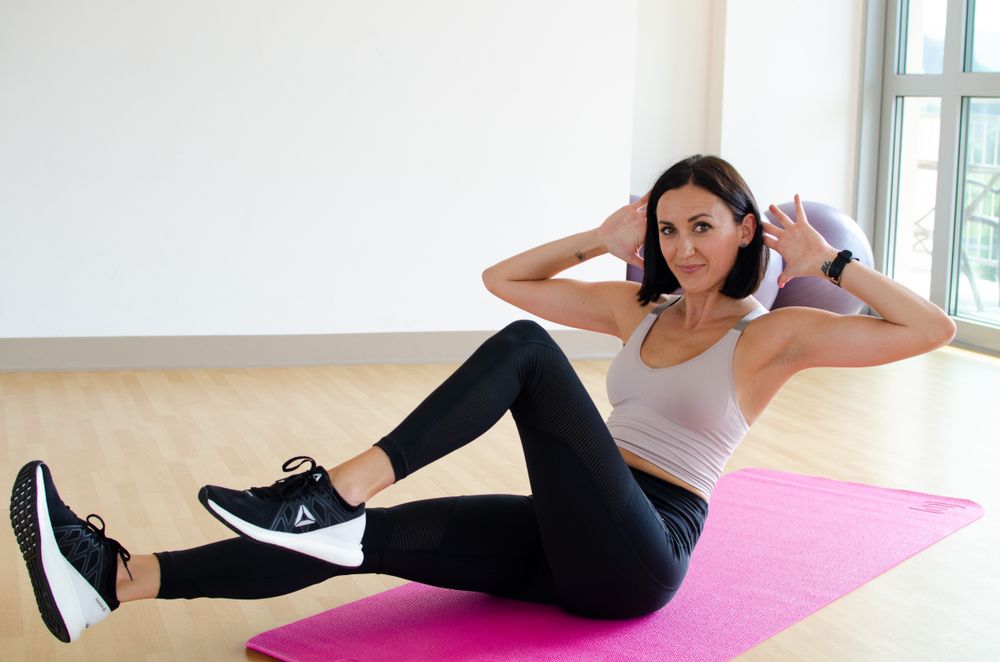
A crunch involves a limited trunk-curling movement. The rib cage moves toward the pelvis while the upper trunk partially leaves its support. A full sit-up involves a larger change in body position and a different contribution from muscles around the hips. These related exercises do not have identical ranges or mechanical demands.
Abdominal muscles contribute to movement, slowing and position control. The lifting phase is therefore only part of the repetition. Preparation and return matter too. Sensation, range and control provide complementary information, rather than one simple visual test that proves whether the exercise is working.
Carrying the head requires coordination
When the head leaves the floor, muscles around the neck contribute to maintaining its position. Expecting absolutely no activity there is unrealistic. Throwing the head forward, pressing the chin forcefully down or allowing the head to trail behind can alter comfort. The aim is a manageable relationship between head and trunk, not a rigidly immobilised neck disconnected from the movement occurring below it.
Muscular effort and pain need to be distinguished. Sharp neck pain, symptoms spreading into an arm, numbness or dizziness call for stopping and reassessment. Continuing or repeatedly returning symptoms may require professional health advice. Assuming that every uncomfortable sensation simply means weak muscles is not justified. More repetitions cannot identify the cause of a symptom or replace an appropriate decision about whether to continue.
Arm position changes the task
Keeping the arms near the trunk differs from placing them farther behind the head. Their position changes mass distribution and can alter the demand. If the hands are behind the head, pulling to finish the lift can redirect the task through the neck.
An instructor may consider another arm position or a suitable support option. Supporting the head should not mean dragging it forward. The purpose of the choice matters more than imposing one placement on every participant. Feedback becomes more useful when the person can distinguish assistance from pulling, and trunk movement from a movement led mainly by the head.
Flexion and range need context
Trunk flexion describes a forward-bending movement. During a crunch, the rib cage and pelvis change their relationship in this direction. Range should be considered alongside speed and load. If the return becomes uncontrolled or the movement is produced mainly through the neck, a smaller range may make the task easier to understand. Larger movement is not automatically a better training stimulus.
A general article cannot decide exercise suitability for somebody with an individual restriction on spinal flexion. Previous health advice, known spinal conditions or symptoms aggravated by movement affect the decision. Another trunk-control exercise may be preferable when appropriate. Not performing a crunch does not exclude every form of core exercise, just as performing one does not establish suitability for every flexion task or load.
Breathing and speed provide clues
A controlled exhalation during lifting can be a useful teaching option. Forcefully emptying the lungs or holding the breath through the whole repetition is not required. Breathing continuity offers information about how the task is being managed. A clenched jaw or an abrupt head movement before lifting may prompt consideration of a simpler variation, without being treated as a diagnosis by itself.
Rapid repetitions can make momentum a larger part of completing the movement. Slowing down creates time to observe lifting and lowering, although moving as slowly as possible is not automatically superior either. Longer effort can increase fatigue. When discussing movement with Gizem Köymen, describing where control changes can be more informative than reporting only how many repetitions were completed.
Read quality before adding repetitions
A set is more than its final number. Increasing head pulling, prolonged breath holding or dropping quickly during the return suggest that the task is changing. A pause or adjustment may be appropriate instead of forcing the original target. There is no universal repetition count for every participant, variation and session purpose. The relevant observations belong to the actual task being performed.
The crunch is one abdominal exercise, not a complete description of trunk function, and it does not guarantee fat loss from a particular area. Other movement directions and control tasks may form part of a broader programme. Technical awareness is about understanding the work being done. Comfortable, clear and controllable movement provides a more useful context for repetition numbers than increasing them without examining the experience.
Further reading: [Mayo Clinic: abdominal crunch technique](https://www.mayoclinic.org/healthy-lifestyle/fitness/multimedia/abdominal-crunch/vid-20084664).

